Space
The SPACE group includes collaborators conducting or planning a series of clinical trials of a polypill strategy for cardiovascular disease prevention. The polypill being evaluated in these trials is the Red Heart Pill made by Dr Reddy’s Laboratories (Hyderabad, India).
The polypill is a single capsule containing four different medicines: a cholesterol lowering medication, two blood pressure lowering medications and aspirin. These medicines are recommended as preventive treatment for people who have survived a heart attack or stroke and for people who are at high risk of such a problem. Currently many people do not benefit from appropriate preventive medicines. This is particularly true in developing countries where access and cost present difficult barriers.
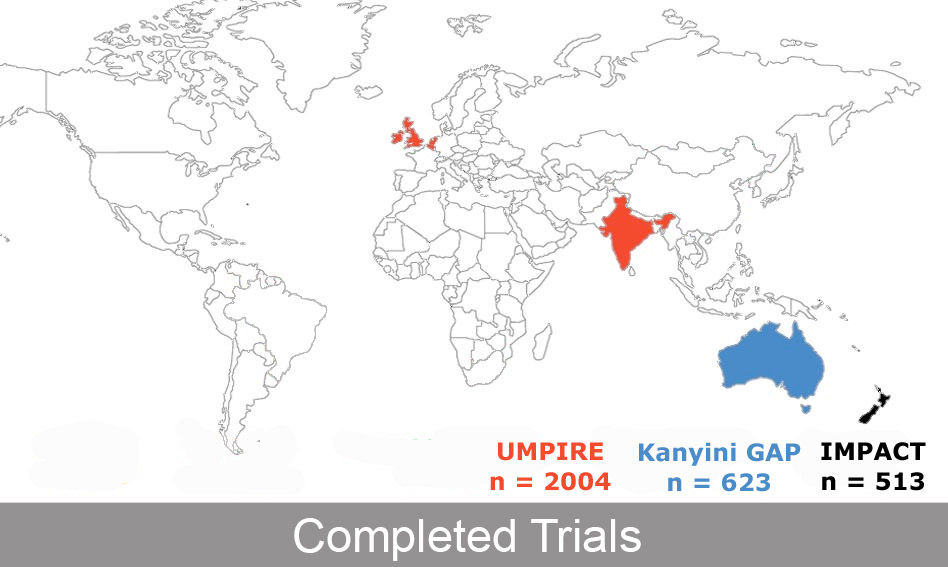
Three trials have reported their results (see publications list for links to the published papers):
- The IMPACT trial in New Zealand (funded by the New Zealand Health Research Council)
- The UMPIRE trial (funded by the European Commission's Seventh Framework Programme – 1004 participants in Europe (UK, Ireland and The Netherlands), 1000 patients in India)
- The Kanyini-GAP trial in Australia (funded by the National Health and Medical Research Council, 623 patients from both indigenous and non-indigenous populations)
Each trial aimed to evaluate the impact of the polypill treatment strategy on adherence to preventive medication in the varying settings of several different healthcare systems. A key question about the polypill is whether patients and prescribers will adopt it with enthusiasm.
An individual patient data meta-analysis was published in 2016 (see below in publications list for article).
Space Collaboration Publications
- IMPACT baseline paper
- Kanyini-GAP protocol paper
- UMPIRE baseline paper
- UMPIRE main results
- Kanyini-Gap main paper
- IMPACT main paper
- SPACE Collaboration meta-analysis
SPACE Collaboration members
- Co-ordinator: Dr Ruth Webster
The George Institute for Global Health, Sydney - Chair: Professor Anthony Rodgers
The George Institute for Global Health, Sydney - Deputy Chair: Professor Anushka Patel
The George Institute for Global Health, India (UMPIRE, Kanyini-GAP) - Professor Alan Cass, Ms Carol Burch
The George Institute for Global Health, Sydney (Kanyini-GAP) - Professor Chris Bullen, Ms Angela Wadham, Dr Vanessa Selak
Clinical Trials Research Unit, University of Auckland (IMPACT) - Professor Simon Thom, Professor Neil Poulter, Ms Jane Field
Imperial College, London (UMPIRE) - Professor D Prabhakaran
Centre for Chronic Disease Control - Professor K Srinath Reddy
Public Health Foundation of India (UMPIRE) - Professor Alice Stanton
Royal College of Surgeons in Ireland (UMPIRE) - Professor Rick Grobbee, Professor Michiel Bots
University Medical Centre Utrecht (UMPIRE) - Professor Wu Yangfeng
The George Institute for Global Health, China - Dr Otavio Berwanger
Hospital do Coração (Cardiac Hospital) , Sao Paulo, Brazil - Dr Andre Pascal Kengne
Medical Research Council of South Africa - Mr Raghu Cidambi
Dr Reddy’s Laboratories India
CONTACT
- Dr Ruth Webster
- SPACE Collaboration Co-ordinator
- The George Institute for Global Health
- PO Box M201
- Missenden Rd,
- Camperdown NSW 2050
- Ph: +61 2 9993 4500
- Fax: +61 2 9993 4502
- E: rwebster@georgeinstitute.org.au